

ARTICLE I: The Legislative Branch
ARTICLE I: The Legislative Branch
SECTION 1: The Legislature
a. Dissolution of Sovereign Nations and Borders
No Territory upon Earth, in any place where human beings reside, shall possess sovereignty or legislative powers outside of those granted by the people of Earth through this Constitution. There shall be no established borders that divide the people of Earth.
There are great advantages in unifying all Nations into one people, indivisible. This law will unify and centralize political power in a World government, with the group of people that it represents identified as the Republic of Earth. “Republic” has always represented a government where the power rests solely with the people, by the people electing representatives that recognize, support, and do the people’s will. Current governments are run by the will of politicians who look out for their own personal interests or the interests of the constituency in their home Country that do not necessarily reflect the interests of the majority of citizens in the rest of the World.
The current Constitution of the United States of America, for instance, allows politicians elected by one State to hold more power and exercise more authority than other equally elected politicians. It allows Congress to assign its own, usually seasoned (multi-term) politicians, to chair powerful committees, even though less-tenured and newer representatives might represent a larger number of people.
Here is a graphic example to illustrate this disparity of power:
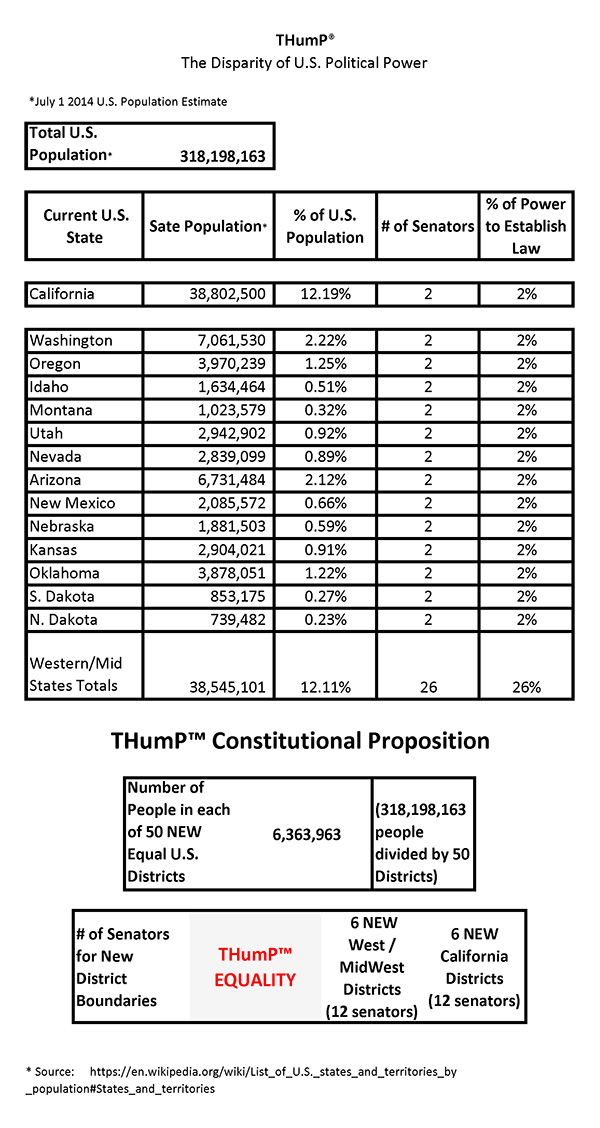
States’ rights and power have caused many (if not most) of the social problems experienced by Americans. The most conservative States in the Union, which have a smaller population than other, more liberal States, wield a greater power in Congress and cause political gridlock, many times inciting prejudice and threatening the right that all humans are created equal. It was a hard fight to convince the Congress of 1862 to abolish slavery; the Congress of 1964 to abolish segregation; and they currently are experiencing some States fighting against homosexual protection and equal liberties. All of these seemingly humane acts that should be obvious, were stalled and fought against by the constitutional rights of States. This new constitutional proposal eliminates the probabilities of inhumane government policies continuing in society because of the minority.
b. Congressional Power to Establish Laws; Term Limits for the Legislative Branch
All legislative powers herein granted shall be vested in a Congress elected every four years by the people and limited to two terms each within any period of twenty consecutive years.
c. Requirement to protect Earth
Legislative powers shall be restricted to acts and procedures in the establishment of laws that support the wants and needs of the people proportionate to the support of the natural laws of Earth and its environs.
d. Houses of Congress
Congress shall consist of a Senate and a House of Representatives.
e. Equality of Congress
Congress shall not choose Seats nor designate Officers. There shall be no Classes, Committees, Chairpersons, or Seats, of any kind, in Congress. Each Member of Congress shall be equal to all other Members, regardless of tenure, age, race, gender, economic status, religion, or sexual orientation.
f. Consensus of Unanimity
Without a consensus of unanimity among its elected Members, Congress shall pass no law incumbent on the people outside of the laws established by this Constitution. There shall be no law without the unanimous consenting vote of each Member of Congress, whether physically present at the time of the vote or not. Congress shall have the option of voting by proxy or electronically, as it may determine from time to time, is in the best interest of any particular Member, or the people of the Republic.
g. Congressional Compensation
Members of Congress shall receive for their services a compensation as described in Section 7 of this Article. Besides that salary and within the period of their elected term: prior to that period within five years, and subsequent to that period within ten years—no Member of Congress or anyone associated with a Member of Congress shall receive from the Republic or from any of its people, or from any domestic entity, or from any foreign person or entity—any present, donation, emolument, office, or title, of any kind whatsoever. The provisions of this sub-section shall be construed consistent with the provisions of Section 1(l.) below.
No Congressional Representative shall, during the time for which that Representative is elected, or within ten years from the end of the period for which that Member was elected, be appointed to any civil office under the authority or compensation of the Republic which was created, or the emoluments whereof which were increased during such time; and no person holding any civil office under or within the Republic, shall be a Member of either House during such civil officer’s continuance in authority and office.
i. Age and Residency Requirements for Congressional Representatives
No person shall be a Representative: 1) who has not attained the age of thirty-five years; and 2) who has not physically resided in a specified District for at least five years.
j. Congressional Replacement Outside of Regular Elections
When vacancies occur in the representation of any District due to death, disability, impeachment, or removal from office for any reasons determined by Congress according to its authority as this Constitution allows, Congress shall prescribe the time, place, manner, and approve and support the cost of a new election by the previously registered voters in the District where the vacancy occurs.
k. Congressional Immunity from Civil Suits and Harassment
Congressional Representatives shall in all cases—except treason, felony, breach of the peace, or violation of any of this Constitution’s Articles, or those of a personal nature involving domestic issues—be privileged from legal process service or arrest during their attendance at the session of their respective Houses, and in going to and returning from the same; and for any speech or debate in either House, they shall not be questioned in any other place by any other person or authority outside of those appointed by this Constitution.
l. Congressional Recognition of Any Person[s]
No Title of Nobility shall be granted to any person, for any reason, by the Congress, nor shall any person holding any office of profit or trust under this Constitution accept of any present, emolument, office, or title, of any kind whatsoever, from any king, prince, or officer of any state or nation.
m. Congressional Website for Complete Transparency
Congress shall maintain an official website. Such website shall provide full transparency of all congressional actions and activities, except those that might impede or affect national security as Congress may determine and prescribe, but requiring the concurrence of the President. Such website shall be updated on a daily basis and kept current within 24 hours of the preceding day. Such website shall be clear and understandable to the majority of the people anywhere throughout the world.
n. Congressional Oath
Before Members of Congress assume the execution of their office, each shall take the following Oath or Affirmation: “I do solemnly swear (or affirm) that I will faithfully serve the people of the Republic of Earth, and I will to the best of my ability, preserve, protect and defend the Constitution of this Republic.”
SECTION 2: Congressional Districts
a. Definition of Congressional Voting Districts
Districts within the Republic of Earth shall be determined according to the total number of registered voters, divided by 50 Districts. Congressional District boundaries shall be redefined every four years by automatic Digital Boundary Definitions determined after the people have registered to vote during each four-year term. Digital Boundary Definitions shall be defined by the number of registered voters and concomitant with their physical proximity according to Article V of this Constitution.
b. District Titles
Each District may preserve the title of its former Nation or State, a combination of both, or the people residing therein may choose another title by majority election of that District’s registered voters.
SECTION 3: The House
a. Number of Representatives
The House of Representatives of the Republic shall be composed of five hundred (500) Representatives, ten (10) from each District, and each Representative shall have one vote.
b. Power of Impeachment
The House shall retain the power of impeachment, but no party shall be impeached without the concurrence of unanimity of the House as prescribed in Section 1(f.) of this Article.
SECTION 4: The Senate
a. Number of Senators
The Senate of the Republic shall be composed of one hundred (100) Senators, two (2) from each District, and each Senator shall have one Vote.
b. Power to Try Impeachments
The Senate shall retain the power to try all impeachments, whether of a Member of Congress, or of the President of the Republic, or of any Member of the Judicial Branch. The Senate shall receive and judge the evidence and findings of impeachment from the House of Representatives at trial. No impeached party shall be formally adjudged and convicted without the concurrence of unanimity of the Senate as prescribed in Section 1(f.) of this Article.
c. Punishment of Impeachment and Conviction
Judgment in cases of impeachment shall not extend further than reprimand and censure by the Senate; it shall not include removal from office. The impeached party shall be liable and subject to indictment, trial, judgment, and punishment, according to law, prior to removal from office.
d. Replacement in Office of the Impeached
Upon impeachment and conviction by judicial trial, the people of the convicted and removed Member’s District shall hold the exclusive power to elect such Member’s replacement during a lawfully convened election according to the power of Congress to call such election. The majority vote of the people of the Republic during a lawfully held election shall be the only power that can replace any Member, President, or Judicial Officer in the event of impeachment by Congress, and conviction and removal from office, as determined by judicial trial.
SECTION 5: Elections
a. Establishment of Elections
Pursuant to Article V of this Constitution, Congress shall oversee and establish the proceedings, laws, times, places, manner, and pay the costs of registering to vote and of the general elections.
SECTION 6: Rules of Proceedings and Adjournment
a. Congressional Self-rule
Each House shall determine the rules of its proceedings and adjournments, given that such rules are restricted to and comply with the authorities and powers granted by the Articles of this Constitution.
SECTION 7: Congressional Assembly and Compensation
a. Full-time Employment Expectations
Congress shall be in session on a full-time basis in accordance with the same laws that determine the weekly and hourly minimums and maximums for the people of the Republic and according to the term limits established by this Constitution.
b. Congressional Pay
Congress shall be paid an annual salary at a rate of two times that of the average annual income of the people of the Republic, and paid out of the Treasury of the Republic.
c. Congressional Overtime Compensation
Only at times of worldwide emergencies shall Congress be approved for overtime hours. Congress shall be paid an overtime hourly wage, in addition to their annual salary, commensurate with the average hourly overtime wage of the people of the Republic.
d. Congressional Vacation and Sick Leave
Congress shall be allowed 30 days a year of paid vacation, and shall be provided the same amount of personal and sick leave that is granted to every person under the Republic by law prescribed by Congress.
e. Congressional Pensions
No Member of Congress shall receive a pension of any kind, at any time, for service in the Congress, unless the law equally provides such pension, of any kind, to all people of the Republic.
SECTION 8: – Revenue Bills, Legislative Process, Veto Power
a. Raising Revenue by Taxation
All Legislative Bills for raising revenue for the Treasury of the Republic, to pay for the debts of the Republic, shall comply with and support the tax code described in Section 9(a.) below. Congress shall not raise revenue by any other means.
b. Veto Power over the Consensus of Unanimity
No other branch of government shall possess veto power over any Bill passed into law by the consensus of unanimity of Congress.
SECTION 9: Powers of Congress
a. Tax Code
TO pay the debts and constitutional obligations under Article IV, and provide for the common defense and general welfare of the Republic, Congress shall be limited to a consumption-based tax rate in its power to establish laws that lay and collect taxes, not to exceed 20%, and based on the annual Gross Domestic Product of the prior year applied to the following economic algorithm: (GS*100) ÷ (GDP – GS); where GDP = Gross Domestic Product and GS = Government Spending
b. Creating Electronic Currency; the Elimination of a Cash-based Economy
TO fund the difference between the tax revenue and the Republic’s debts, Congress shall have the power to issue currency, fix the standard, measures, and regulate the value thereof, There shall be one World Currency. The World Currency, its standards and measures, shall be of an electronic nature. Congress shall not have the power to coin or print money of any type. All financial transactions between the people of the Republic, or between any entity established among them, shall be of an electronic nature.
c. Power to Regulate Inflation on Human Basic Necessities
TO regulate the inflation on the cost of the goods and services provided under Article IV, not to exceed 1.5% per annum. Congress shall have no power to regulate the inflation on any other goods or services.
d. Power to Support Infrastructure
TO establish, support, and maintain a modern and sound infrastructure of the Republic according to the needs and wants of its people.
e. Power to Regulate Copyrights, Patents, and Trademarks
TO promote the progress of Science and useful Arts, by securing for limited times to Authors and Inventors, the exclusive Right to their respective Writings and Discoveries.
f. Power to Establish One Worldwide Federal Law Enforcement Agency
TO raise and support a single Federal Law Enforcement Agency, which incorporates into one Agency, all former National Militias and Law Enforcement Agencies of any kind; whose jurisdiction shall extend to all parts of Earth; and TO assign their particular duties, and establish their protocols and proceedings. TO give this Agency the necessary authorities and rights to protect and execute the laws of the Republic and this Constitution; TO determine a just punishment for any citizen of the Republic who violates any law within the boundaries of the Republic. Congress shall pass no law granting immunity from punishment to any person, for any reason, at any time.
g. Power to Create Laws to Protect the Constitution
TO make all Laws which shall be necessary and proper for carrying into Execution the foregoing Powers, and all other Powers vested by this Constitution in the Government of the Republic, or in any Department or Officer thereof.
Section 10: Limits on Congress
Congress shall be limited in its powers according to the provisions and Articles described in this Constitution. Congress shall not have the power to supersede, at any time, the powers and authorities granted to it by this Constitution.
This provision establishes the power and significance of this Constitution and makes it very, very hard to amend the Constitution and establish laws that in any way bypass or circumvent the desires of the people who created this Constitution for themselves, by themselves, and of themselves.